

Past performance should not be taken as a guide to future performance. The value of investments, and the income from them, can fall as well as rise and you may not get back what you put in. You should continue to hold cash for your short-term needs.
Overlay

NatWest Invest
Mid-year Investment Outlook 2026
Watch a two-minute summary of our Mid-year Investment Outlook
The first half of 2026 showed how quickly things can change. The conflict in the Middle East caused markets to fall at first, but they recovered more quickly than many expected. This is because markets are forward looking and care not just about earnings this year, but next year, and five years from now, and 10 years from now. And overall, the bigger picture has remained fairly positive, with steady economic growth, strong company performance, and continued progress in areas like artificial intelligence, more recently things have shifted slightly.
Inflation has started to rise again, and interest rates could increase in response. That can make things more challenging for markets, but on balance, we remain positive, given healthy economic growth and robust corporate profits in the UK, rising petrol prices have been one of the most noticeable impacts this year, but what stands out is how people have adapted. Our analysis of our customers' card spending shows that people were buying around 9% less petrol by the middle of May compared to the start of March. This suggests that rather than simply absorbing higher costs, people adjusted their behavior either by driving less or topping up more carefully. Households' ability to use less fuel and manage their budgets carefully shows a level of resilience. Even with rising costs, overall spending has stayed relatively steady.
There are also longer-term changes helping to ease the pressure. For example, more people are switching to electric vehicles, which reduces reliance on petrol. Overall, households and businesses are managing their finances well, continuing to spend, but keeping a close eye on costs.
Looking ahead, there are a few important events that could influence markets, including the US midterm elections and talks between the US and China. These could create some uncertainty in the short term, but overall the outlook remains reasonably positive, with continued economic growth and solid company performance expected. One key area to watch will be inflation and interest rates, and how they develop from here in a fast-changing environment. Maintaining a long-term view and staying flexible will be important in the months ahead.
Part one: Our views and positioning
Managing the unexpected
The first half of 2026 delivered a curveball for investors. The conflict in the Middle East, which began at the end of February, initially unsettled markets and knocked performance. But despite ups and downs as tensions changed, markets stayed resilient and delivered solid returns.
It came down to perspective. Markets don’t just focus on what’s happening over the next few days or weeks. They look further ahead and ask what the world might look like in months or even years.
This longer-term view suggested that, while the US-Iran conflict could cause bumps along the way, stock markets were still on relatively solid ground. Steady economic growth, encouraging company profits and ongoing support from policymakers were providing plenty of reasons to feel relatively positive. This was boosted further by excitement around artificial intelligence (AI), with many of the companies involved delivering strong results.
These solid foundations meant that investors who stayed the course during the escalation in the Middle East were ultimately rewarded. Markets fell at first but, as we’ve seen after other unexpected events, they soon recovered.
This is exactly what the investment team at Coutts – the bank behind our investment products – did after carefully reviewing the data. They were already holding more stocks than bonds relative to their benchmark – based on their positive outlook for growth – and they didn’t change this when the conflict began. As a result, our portfolios and funds benefited from the market recovery.

The impact of rising interest rates
Now, at the halfway point of the year, the picture has shifted slightly. Inflation is rising again, partly due to higher oil prices and a stronger-than-expected economy.
As a result, we’ve moved from a period where interest rates were falling to one where they may go up (central banks typically increase interest rates to help control inflation).
This matters for investors because higher interest rates can affect share prices. They increase borrowing costs for companies and encourage people to save rather than spend – both of which can put pressure on profits.
Our latest positioning
Against this backdrop, the Coutts team have slightly reduced their exposure to stocks. They still favour them over bonds, as the economy continues to grow and companies are still performing well – both positives for stock markets. However, higher interest rates could limit returns over the rest of the year.
The team have also adjusted where they invest. They’ve moved some money out of US and European stocks and into emerging markets. While US companies are still performing well, growth has slowed a little. Europe, meanwhile, is more exposed to higher energy costs linked to the Middle East conflict.
Emerging markets, on the other hand, offer a different opportunity. Company performance has been strong, but stocks remain reasonably priced. These markets are also benefiting from the growth of AI. Countries such as South Korea and Taiwan play a key role in global technology supply chains, particularly in areas like semiconductor production and hardware manufacturing.
Managing your money
The Coutts team decided to make these changes after following their ‘Anchor and Cycle’ investment process. Anchor is about long-term analysis – looking ahead five years or more. Cycle is about current conditions – how the economy is doing right now. Together, they provide a well-informed, data-driven picture of the economy and markets.
But the team are also highly agile. They stand ready to respond to market moves as and when they happen, working to make the most of positive times while acting fast when things change.
Part two: UK economy spotlight
UK economy spotlight: How higher petrol prices are shaping spending patterns
People have changed their buying behaviour to deal with this year’s rising fuel prices, demonstrating the latest sign of a financial resilience that could serve the UK economy well.
One of the most immediate effects of the Middle East conflict has been rising energy costs. For many people, the most noticeable impact has been the price of petrol.
After the Strait of Hormuz was effectively closed at the start of the US‑Iran conflict — restricting the transport of around 20% of the world’s oil — the reaction from some parts of the energy market was more muted than expected. For example, wholesale gas price rises were relatively small compared to the surge seen after Russia’s invasion of Ukraine in 2022.
But that wasn’t the case at the petrol stations. Prices rose sharply, from around 132p a litre at the start of February to around 160p at the start of June, according to the RAC Foundation.
Our analysis of our customers’ card spending shows that, as a result, people were buying around 9% less petrol by the middle of May compared to the start of March. This suggests that, rather than simply absorbing higher costs, people adjusted their behaviour — either by driving less or topping up more carefully.
We also found that more customers were choosing to buy smaller amounts of fuel each time they visited a petrol station, although close to half of them were filling up more frequently — a clear sign of careful budgeting and day‑to‑day money management.
As a result, this year’s rise in fuel costs may have less impact on overall household finances than expected, leaving more money available to be spent elsewhere, and supporting the UK economy.
Power to the people
One factor helping to soften the impact of higher fuel prices is the growing number of electric vehicles.
Latest figures from the Department for Transport show that, by the end of 2024, the number of licensed zero‑emission vehicles on UK roads had increased by 37% compared to a year earlier.
Fast forward to May this year, and around 43,900 fully electric cars were registered in the UK — accounting for just over 27% of all new cars, according to the Society of Motor Manufacturers and Traders. That’s up from around 22% in May 2025.

A generational difference
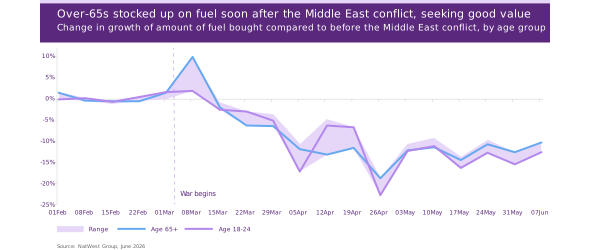
Our analysis also shows some interesting differences between age groups, with those aged 65 or over more focused on getting good value for their money.
As prices initially rose, customers in this age group increased their fuel purchases in March — possibly to get ahead of further price rises or avoid potential shortages.
This is an important insight for businesses, highlighting the value of understanding how different customers might respond to changing conditions.
Ongoing resilience
The way people in the UK have responded to rising fuel costs is the latest example of their resilience.
Over the past decade, the UK economy has faced repeated challenges — including a pandemic, high inflation, and ongoing global uncertainty — as well as energy shocks.
But people have adapted. Many are more proactive in managing their finances, whether that’s adjusting spending habits or switching to better savings or mortgage deals when appropriate. Businesses have also become more agile, adapting to changing markets and customer needs.
Confidence may have been affected, but overall the figures suggest the UK public has remained relatively calm.
Cautious spending, steady finances
Given these strong foundations, households and businesses are still spending and investing — but doing so more carefully.
For example, there have been signs that spending on non‑essential items like clothing has softened, while overall spending growth remains modest, according to figures from the Office for National Statistics.
Overall, households and businesses are navigating a challenging environment while keeping their finances on a stable footing. This year’s energy shock is another test, but one they appear to be managing well – with resilience that continues to support the wider UK economy.
Part three: Looking ahead
What to watch in the months ahead
Looking ahead to the rest of the year, there are several major events to watch. In November, the US will hold its mid-term elections, when most seats in Congress are contested. The results of these elections could very well influence the economic policy of the world’s largest economy.
Before that, China’s President Xi Jinping is due to visit Washington in September – a meeting that may give important signals about global trade.
For now, these are uncertainties. And as always, the Coutts experts remain focused on the facts and long-term fundamentals of investing.
They will be keeping a close eye on any policy changes that could affect investments, particularly as inflation picks up. But overall, they expect continued economic growth and solid company performance over the rest of this year.
View your investment
Add to your investment, transfer an ISA or pension from elsewhere or take a look at key documents and more.