Overlay
Unlocking venture capital

Bridging the scale-up funding gap: a market snapshot

What’s the most persistent barrier to growth?

As we embark on the first quarter of 2026, the UK venture capital ecosystem is gaining momentum, with early-stage signs of strength in dealmaking. While some uncertainties remain, the overall outlook reflects a market adapting and positioning itself for growth.

However, the path forward is far from straightforward. Recovery in fund economics and investor confidence is gradual, and the timeline to a broad resurgence in venture deal activity remains uncertain. Against this backdrop, the UK’s startup scene continues to demonstrate remarkable resilience and adaptability. Early data from 2026 reveals that progress has not stalled; significant megadeals and the emergence of new unicorns illustrate the enduring strength and ambition of British innovation, particularly within the burgeoning AI sector.

Yet, structural challenges—most notably the scale-up funding gap—remain at the forefront. This report offers not only a quarterly update on the UK venture landscape but also an in-depth exploration of the shortage of growth capital and its impact on scale-ready founders. It addresses why this gap exists, how it shapes the trajectory of British startups, and the critical role that venture debt may play in bridging it.

The insights are designed to inform founders, investors, and stakeholders as they navigate shifting market dynamics and seek to unlock new pathways to growth. From the structural realities of fund sizes and cross-border capital flows to the evolving role of debt as a strategic financing tool, the report provides a comprehensive view of the variables shaping the UK’s innovation economy. Whether you are a founder seeking to scale, an investor allocating capital, or a policymaker charting the future, this update aims to equip you with the knowledge to make informed decisions in a landscape defined by both challenge and promise.

As the UK continues its journey towards global competitiveness and sustainable growth, it is clear that closing the scale-up funding gap will require coordinated effort, innovative financing, and long-term commitment. While the path ahead may remain complex, NatWest stands ready to support founders and investors navigating this environment- providing the capital, expertise and strategic insight needed to help founders scale with confidence. By working alongside the venture community, we aim to play a practical role in unlocking growth and enabling the next generation of UK success stories.

A futuristic looking train driving through an urban envrionment.

UK venture ecosystem quarterly update

For UK founders, scaling ambition increasingly depends on non-traditional funding routes.


Source: Geography: UK, Timeframe: 1/1/2025 - 26/02/2026, As of: 26/02/2026

UK VC deal activity

The UK venture ecosystem kicked off 2026 with strong momentum in dealmaking activity accompanied by improving but still uncertain macroeconomic indicators. The inflation rate had inched closer to the Bank of England’s 2% target rate, but impending energy price volatilities may disrupt the path to 2%.[1] The macroeconomic environment is taking steps in the right direction to improve fund economics, which is necessary for a broad recovery in venture dealmaking. However, emerging geopolitical conflicts could threaten the UK venture ecosystem’s recovery timeline by raising energy costs and disrupting global supply chains. The end of 2026 is still out of sight. These macroeconomic and geopolitical uncertainties will take months to unfold, and the extent to which they will impact investor risk appetites, fund economics, and the broader venture ecosystem is far from a foregone conclusion.

Despite such uncertainties, initial readings of venture funding data in 2026 suggest that progress was not lost. In less than a quarter, megadeals (VC deals exceeding £100m) closed for Kraken Technologies, Roark, Tenpoint Therapeutics, OLIX Computing, and Pipeline Media. Roark emerged as a unicorn, and early- and late-stage investments saw materially larger deal sizes and valuations on average. UK venture capital invested YTD remains elevated (£2.8bn) at levels higher than the pre-pandemic era, yet deal volume is at its slowest pace over the same window. AI is driving the concentration: The average UK AI deal size has more than doubled from £8.9m in 2025 to £19.4m YTD. These trends point to 2026 as a year of significant capital concentration into fewer, larger deals.

Corrections in fundraising dynamics take time to materialise, and current signals allude to a lengthened timeline to recovery and continued capital concentration. Only four funds have closed YTD, but their average size exceeds the averages of the past eight years. Furthermore, the process of closing funds remains challenging. These few funds took an average of 28.7 months to close, compared with 11.3 months the prior year. NatWest’s previous report (PDF, 7.9MB) positioned 2026 as an inflection point for fund economics. This view can still hold true despite the macroeconomic uncertainties as long as the UK’s tech-dominant startup scene remains insulated from geopolitical sensitivities.

The impact of macroeconomic uncertainties is unlikely to materialise in the data for months, but the dearth of scale-up capital is a salient and persistent challenge today. As such, this report provides not only a quarterly update on the UK venture landscape and the variables that shaped it but also a deep dive into the scale-up funding gap, why it persists, and how to address it.

1: “What to Expect From February’s UK Inflation Data,” Morningstar, Christian Mayes, 23 March 2026.


Jump back to top of page

A futuristic looking train driving through an urban envrionment.

Identifying the scale-up funding gap

Why domestic capital falls away as start-ups scale.

At a glance:

UK scale‑ups face a structural late‑stage funding gap.

Smaller UK funds limit the ability to scale globally.

Venture debt and overseas capital are filling the gap.

A dearth of scale-up capital acutely impacts founders. Scale-ready startups with a viable and market-competitive product must source growth capital elsewhere, delay growth plans, or alter initial exit plans to provide earlier investors with returns on their capital, which also impacts the valuation at which a founder must sell. It is therefore more critical than ever for founders to know when to expect this roadblock and how to overcome it.

Dry powder, fund sizes, and deal sizes are structural variables that impact the availability of scale-up capital. At the same time, the participation of cross-border investors can unveil the stages of the financing cycle where startups face the scale-up funding gap.

Despite having the dry powder to deploy, UK funds are not structurally conducive to the long-term support and growth of a billion-pound company, let alone a portfolio of scaled, hundred-million-pound tech companies. UK dry powder levels have stagnated near record highs ($23.1bn YTD), while fund sizes have skewed smaller, in the £50m to £250m range. Institutional capital, such as pension fund capital, has also been underallocated to private markets compared to the US, leading to a smaller pool of capital for GPs to raise from.

Share of UK VC fund count by size bucket

One of the greatest pieces of evidence of the UK’s scale-up funding gap can be seen in how capital is deployed. While fund sizes usually shape how allocators select investments, UK and US average fund sizes remain comparable, suggesting another structural challenge is contributing to the scale-up funding gap. In 2025, UK funds raised an average of £83.2m in 2025, compared with $122.8m (approximately £92.6m) for their US counterparts. In other words, US funds raised in 2025 were only 11.3% larger than UK funds on average. Yet funding outcomes are disparate. The UK’s fundraising dynamics structurally favour an early-stage ecosystem. Pre-seed/seed and early-stage deals continue to represent well over half of UK VC deal volumes. Nearly 50% of deals closed YTD were small (under £5m), while about 80% of all capital invested (£2.2bn) came from larger deals (£25m+).

The US saw a similar deal count distribution—almost 60% of US VC deals were under £5m—but 97% of venture capital invested (£170.8bn) flowed into deals exceeding £25m, reflecting a greater capacity to deploy at scale. The culprit is not fund size in isolation, but the aggregate depth of the market: The UK has fewer funds, with a structural bias toward earlier stages and limited follow-on capacity to support companies through successive large rounds. It is this gap—a shortage of domestic equity at the scale-up stage—that makes the case for venture debt as a complementary tool capable of extending runway without having an equity investor be available at the right moment.

While the UK has an active cohort of growth-stage investors, the overall pool of domestic late-stage capital remains comparatively shallow. The funding gap has, however, fuelled a targeted investor response. Active late-stage investors include Octopus Ventures and Balderton Capital. While government-backed initiatives to close the scale-up funding gap continue to evolve, the UK has nonetheless produced a remarkable cohort of scaled, world-class companies—from Arm and DeepMind to Revolut and Darktrace—that demonstrate the potential of British innovation on the global stage.

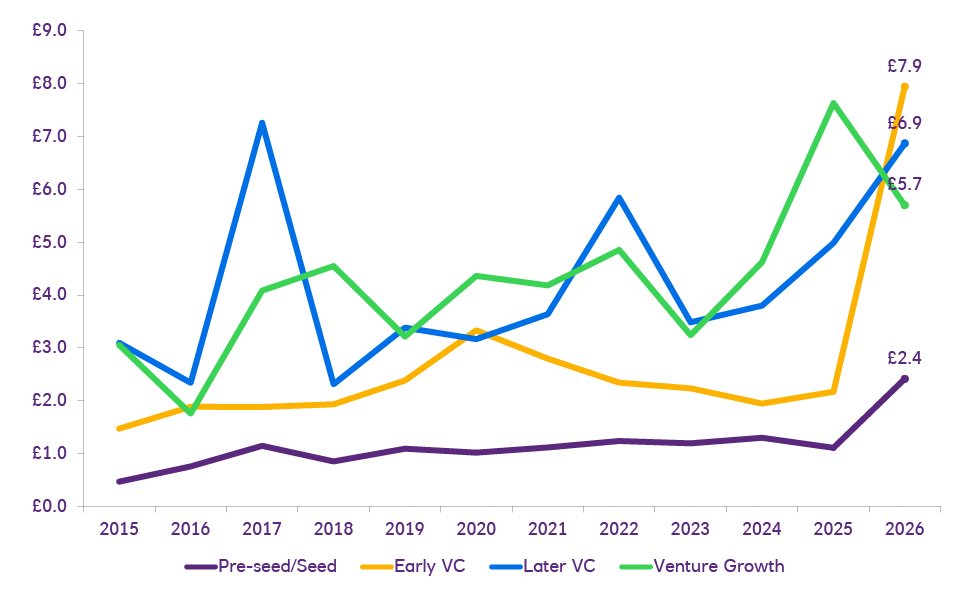
Average UK VC deal value (£m) with only UK investor participation by stage

Domestic funds, even when paired with dedicated capital targeting the scale-up funding gap, often lack the size necessary to lead or meaningfully participate in very large late-stage rounds. While unicorns are rare by default—dependent on alignments between competitive business models, competent management, governance, and market tailwinds, among other factors—this challenge is even more pronounced when it comes to facilitating the growth and maturity required to reach unicorn status. As companies mature, they frequently require £100m-plus financings to compete globally—cheques that US growth funds can routinely write but UK managers often cannot without syndicating internationally. The result is either stalled scaling, earlier exits, or reliance on overseas capital.

The disparity in unicorn formation underscores the magnitude of the gap: The US has produced roughly 880 unicorns to date, compared with 32 in the UK. While ecosystem size and market depth naturally differ, the contrast highlights how limitations in late-stage capital formation constrain the UK’s ability to systematically produce and retain globally scaled companies.

Doing more with less has its limits

This is not to say that founders cannot do more with less. In a more constrained fundraising environment, UK founders have demonstrated notable resilience, displaying strong levels of capital efficiency and placing greater emphasis on revenue quality, durable unit economics, and cash discipline. UK founders that raised venture funding in 2025 had a median VC burn rate—the amount of capital raised divided by the number of months between rounds—of £110,000 per month compared with £292,000 in the US. Aggregated data suggests that UK founders are operating at a higher degree of capital efficiency than their US counterparts. However, this benchmark discounts a startup’s total amount of cash on hand and structural market dynamics, both of which impact a founder’s decision or ability to raise capital. Whether the result of a strategic decision or a product of market dynamics, UK founders are almost 2.5x leaner than US startups.

Late-stage UK startups in particular possess a higher median VC burn rate of £330,000 per month—in line with expectations of growth capital spending at the scale-up phase—emphasising a need to fill in this financing gap. Even though structural challenges, such as a stalled fundraising and exit environment, may necessitate a disciplined approach to capital efficiency, complements to equity financing, such as venture debt, become even more salient in the effort to close the scale-up funding gap.

In some cases, this discipline has translated into significant value creation. For example, gene therapy company Ikarovec is expected to achieve a 45.3x valuation step-up from its 2024 seed round to its most recent financing in October 2025 once the round closes.

Nonetheless, capital efficiency does not eliminate structural constraints. Fund sizes and regional capital availability can impose a ceiling on how quickly—and how far—a startup can scale. The UK’s largest startups are typically backed by domestic investors at their earliest stages. However, as companies mature, each successive round has increasingly relied on cross-border capital to support larger cheque sizes and global expansion.

Average UK VC deal value (£m) with cross-border investor participation by stage

The scaling gap is particularly visible in YTD cross-border deal data. Across every financing stage, UK VC rounds that included at least one overseas investor were larger on average than those backed solely by domestic capital. The divergence is most pronounced at the late stage: The average late-stage deal with cross-border investor participation was 6.3x larger than the average without. A deal size premium is also evident earlier in the lifecycle: Pre-seed/seed rounds with cross-border investor participation were 1.5x larger on average, and early-stage rounds were 2.5x larger. However, the late-stage differential is the most consequential. Three of the five megadeals completed YTD featured cross-border investors. In effect, overseas capital is not merely supplementary; it is often decisive in enabling UK companies to raise at a globally competitive scale.

For founders who fall outside the narrow mandate of cross-border investors—which tend to prioritise the largest and most mature opportunities—the domestic venture debt market has played an increasingly important role in easing founders’ fundraising pressures. The UK venture debt landscape remains concentrated, with a relatively small group of UK-based commercial and investment banks actively serving local venture-backed companies, like NatWest. However, these handful of bank lenders are attributed to billions of pounds of venture debt dollars issued each year.

Venture debt's growing role

Private debt funds are also materially enhancing the UK’s startup credit ecosystem, raising £51.5bn in 2025—exceeding the value of all venture debt loans issued over the past decade (£41.9bn)—although the majority of private debt fundraising focused on other strategies besides venture debt, such as direct lending and distressed debt. Despite a 48% year-over-year decline in private debt volumes, scale-ready companies still stand out as strong candidates for this funding as private debt managers continue to attract substantial investor capital across fewer private debt funds.

Venture debt therefore represents a critical complementary tool within the ecosystem. While it cannot fully substitute for deep late-stage equity pools, it can extend runway, reduce dilution, and provide growth capital to companies that may not yet command large cross-border rounds. As the next section explores, venture debt is positioned to play a larger role in addressing the UK’s structural scale-up funding gap—and in shaping which companies ultimately reach global scale.

“All in all, venture debt can be used in a number of different ways, ranging from providing runway extension through to financing specific growth investments. For the right company at the appropriate stage, debt can be a cost-effective and flexible tool to consider as part of their capital strategy—often reducing the amount of equity needed to be raised. It enables founders to diversify their funding sources, reduce dilution, and provide optionality,” says Ruari Phillips, Head of Venture Debt & Growth.


Jump back to top of page

A futuristic looking train driving through an urban envrionment.

How debt can serve as growth capital

Used well, venture debt moves beyond runway extension to fund real, scalable growth.

UK venture debt deal activity

UK startups need sufficient capital to execute ambitious business plans, expand internationally, and establish credibility in competitive global markets. In an ecosystem long constrained by a scale-up funding gap—often bridged only by cross-border equity investors—venture debt offers founders an alternative path to growth capital through partnerships with banks and specialist lenders.

When macroeconomic-sensitive investors and LPs retrench, lenders can become not just complements to equity but essential components of the capital stack. The use of venture debt has accelerated over the years, peaking in 2022 at 477 venture debt deals amounting to £7.6bn. The loan volume normalised down to 272 in 2025. YTD figures put venture debt’s rise into perspective: For every 13 VC deals closed in the UK so far this year, one venture debt deal was completed.

In fact, 2026 has seen some of the highest venture debt loan values since 2023 compared with historical YTD trends. Loan sizes remain large, with 2025 marking the third consecutive year where annual loan values exceeded £5bn following the near-zero interest rates of the pandemic era, while venture debt loan issuance volumes have moderated to pre-pandemic levels, exhibiting signs of concentration in 2026.

This concentration of loan value has been disproportionately directed toward later-stage companies. Scaled venture-growth-stage startups—a subset of late-stage companies—have accounted for 47.6% of venture debt loan volume and 89.5% of total loan value YTD, and nearly half of venture-growth companies raising VC have secured venture debt in this time frame. While minimising dilution is often cited as a motivation for pursuing debt, the more salient driver at these stages is access to meaningful growth capital. Companies raising large debt facilities are typically funding expansion, infrastructure, and other balance-sheet-intensive strategies—not merely extending runway.

UK venture debt deal activity between 1 January and 26 February

The UK software sector—the largest group of venture debt borrowers in volume and value terms—illustrates how venture debt is being used as true growth capital. In 2025, software startups represented 20% of UK venture debt loan volumes and almost 60% of venture debt loan values. The majority of borrowers were scale-ready late-stage companies deploying debt to fund growth strategies, infrastructure requirements, or loan book growth. Zepz—owner of WorldRemit, a digital cross-border remittance software brand—raised £127.8m in venture debt to invest in technological improvements to its remittance platform; Nscale secured a £1bn GPU-backed delayed draw term loan—the largest venture loan in the UK in the past decade—to purchase GPU infrastructure; and car financing solutions provider Carmoola secured a £300m asset-backed securities facility from NatWest and Chenavari Investment Managers to grow its debt capacity and service more car loans in the UK.

These transactions demonstrate that venture debt in the UK is increasingly tied to infrastructure financing, asset-backed growth, and the scaling of proven business models—not solely bridge financing or runway extension. Companies that demonstrate the ability to repay the loan—whether from a capital raise, revenue generation, or liquidity event—are best positioned to access such facilities.

Debt can carry negative connotations, particularly in early-stage ecosystems accustomed to equity-led financing. However, when deployed strategically, debt can serve many of the same purposes as equity while preserving ownership, accelerating access to capital, and supporting valuation discipline. Should the current market environment not be conducive to a founder’s valuation expectations, debt can provide them with the flexibility to align their exit timeline with a more favourable market environment, enabling companies to stay private for longer.

For companies with predictable revenues and strong unit economics, debt can be particularly powerful. Demonstrable revenue generation and balance sheet strength reduce lender risk and expand borrowing capacity, allowing founders to fund capital-intensive growth initiatives without resetting valuations or absorbing outsized dilution. In this context, debt is not a distress signal but a financing optimisation tool.

UK companies that secured venture debt as a share of all UK companies that raised VC

A futuristic looking train driving through an urban envrionment.

Where US and UK strategies diverge

Similar deal patterns mask stark differences in market maturity.

At a glance:

US venture debt is larger, later‑stage and more embedded.

UK venture debt remains smaller and less familiar to founders.

Debt is increasingly a strategic growth tool, not a last resort.

Share of UK venture debt deal count by stage

On the surface, US and UK venture debt markets share similarities: Loan issuance has been concentrated in late-stage and venture-growth companies, and loan sizes have grown faster than loan counts in recent years. However, structural differences and familiarity with debt financing shape how each ecosystem’s founders deploy debt.

In the US, the private debt ecosystem is markedly larger and more mature, but the material differentiator between the US and the UK is familiarity with debt as a financing tool. In 2025, lenders issued $62.4bn across 943 venture debt loans in the US, compared with the UK’s £5.3bn across 272 loans. In recent years, AI infrastructure financing has been a primary driver of venture debt loan value growth.[1] At the same time, companies are remaining private for longer and scaling to larger revenue bases before exiting, necessitating significantly larger debt facilities. As such, the median early-stage loan size in the US has seen relatively little movement, while the expansion in aggregate venture debt value was largely attributable to larger, later-stage financings. A stalled exit environment and the capital demands of AI infrastructure have played instrumental roles in accelerating US venture debt issuance.

These structural tailwinds have driven an increase in both VC-backed startup borrowing activity and the perception of debt as a tool, not a burden. In a survey conducted by US debt provider Runway Growth Capital, 61.3% of respondents did not consider venture debt to be “rescue financing”—emergency funding that serves as a financial lifeline for companies facing the end of their cash runways, unexpected funding gaps, or other challenges—and 41.7% were considering using venture debt to fund their startup over the next 12 to 18 months.[2]

Share of UK venture debt deal value by stage

In contrast, the UK venture debt ecosystem remains comparably underdeveloped, reflecting a set of structural constraints. Institutional investors continue to underallocate to private markets—and to venture debt strategies in particular—limiting the overall supply of capital available for startup lending.[3] At the same time, the number of dedicated venture debt providers remains relatively small, especially when measured against the financing needs of Europe’s largest late-stage venture market. The UK consistently accounts for approximately 30% of European late-stage deal volume.

This supply-demand imbalance has tangible downstream effects. With fewer debt providers and less available debt capital, UK founders are less familiar with venture debt as a financing tool than their US counterparts. By contrast, US founders have a longer track record of incorporating venture debt into their capital strategies to extend runway, reduce dilution, and optimise outcomes.

While non-bank lenders account for the majority of venture debt activity in the UK, banks can play a differentiated role. A banking relationship offers not only access to credit but also the potential for a long-term partnership—providing continuity, balance sheet support, and ancillary services as companies scale. As the ecosystem matures, these relationships will likely become increasingly valuable for founders navigating an evolving venture financing landscape.


1: "AI and a New Scale of Startups Took US Venture Debt Funding to Another Record," PitchBook, Jacob Robbins, 2 February 2026.

2: "Venture Debt Review 2024 - 2025," Runway Growth Capital, February 2026.

3: "Venture Debt: Why It's Attractive for Founders, Investors and the UK Economy," UK Private Capital, Mei Lim and Sonia Powar, 28 May 2025.

Range of UK late-stage venture debt round sizes (£m)

A futuristic looking train driving through an urban envrionment.

Why closing the gap matters

Without reliable growth capital, UK founders risk stalling scale just as ambition and opportunity peak.

The UK’s inventory of scale-ready companies is only growing, and founders will need the capital and debt to scale lest they forgo the opportunity to join a burgeoning cohort of world-class startups. Amid the uncertainties shaping 2026, capital allocators will continue to face fundraising challenges, but institutional capital is not the only source of startup funding. Venture debt has emerged as a pragmatic and increasingly strategic complement to equity financing. Founders are already partnering with venture banks to extend runway, finance capital expenditures, expand marketing efforts, grow loan books, or pursue M&A. The choice between institutional equity and venture debt ultimately depends on a founder’s tolerance for dilution, appetite for balance sheet risk, desired level of investor involvement, and the prevailing market conditions. When equity markets tighten, alternative financing strategies become not only practical but also essential. In an environment of slower or delayed fundraising activity in the UK, venture debt offers continuity. It allows companies to continue executing their scaling plans even as traditional VC investors pull back.

From funding gap to growth lever

Furthermore, venture debt’s relevance is not confined to downturns. Even in a stabilising or improving macroeconomic environment, debt remains a strategic instrument rather than merely a fallback. In volatile equity markets, particularly amid rapid technological shifts such as the AI revolution, valuation sensitivity is heightened. Venture debt enables founders to fund expansion while minimising ownership dilution and maintaining greater control over valuation inflection points. For companies not just scaling but transforming—from retooling go-to-market strategies, to commercialising frontier innovation, to entering new geographies—debt can provide flexible growth capital without triggering repricing risk. Used thoughtfully, it becomes a tool for timing optimisation as much as capital access.

Closing the UK’s scale-up funding gap will ultimately rest on three forces: regulatory reform, cross-border capital, and venture debt. The Mansion House Reforms are intended to funnel institutional capital into alternative assets, which could potentially result in more funds raised, larger funds raised, or a mix of both outcomes. As discussed in NatWest's previous report (PDF, 7.9MB) on UK innovation,[1] cross-border capital has traditionally served as the bridge to scale and growth. The UK's most notable and valuable startups are backed by overseas investors; this trend is unlikely to reverse as UK entrepreneurs continue to build high-growth opportunities and investors seek diversified yield-generating opportunities. However, venture debt is worthy of further exploration in the UK. In larger debt markets like the US, venture banks are essential partners for enabling scaling. With over 10,500 VC-backed companies to serve, debt can play a much larger role in the UK startup landscape, from addressing the scale-up funding gap problem to becoming a staple financing tool in the startup tool kit.

Methodology

PitchBook has defined a new class of venture-backed startups – venture growth – as VC dynamics have evolved, like companies staying private for longer and sourcing capital from private instead of public markets. They are a subset of late stage start ups that have received financing beyond the typical Series D rounds, they have closed series E or later financing and are further defined by following characteristics: age, number of VC rounds, company status and participating investors. Cross-border deals are classified as deals with at least one non-domestic investor participating. Non-domestic investors are determined based on the location of the investor’s headquarters. For the purposes of this report, they are defined as firms headquartered outside the UK. Fundraising figures are based on the location of the fund rather than the location of the investor. While the compiled data underlying the featured graphs and report analysis concludes at 26 February, 2026, quarter-end figure comparisons will show marginal differences and do not impact the report’s overall conclusions.

Reports are prepared in accordance with PitchBook’s methodology, which is described in detail on the PitchBook report methodologies page.


1: “UK Venture Funding Surges Into AI as Investment Concentrates in the Largest, Most Proven Scale-Ups, NatWest’s ‘Future of UK Innovation’ Report Finds,” NatWest, 4 March 2026.


Jump back to top of page

This document has been prepared by National Westminster Bank Plc and its affiliates (together “NatWest”) for the intended recipient (the “recipient”). This document has been delivered to the recipient for information purposes only. It does not constitute an offer or invitation for the sale, purchase, exchange or transfer of any investment, loan or asset and is not intended to form the basis of any decision or evaluation by the recipient and should not be regarded as a recommendation by NatWest that the recipient should participate in any transaction. The recipient should seek its own financial and tax advice and perform its own independent investigation research and analysis, and shall rely solely on its own judgment, review and analysis to determine its interest in participating in any transaction. Nothing in this document should be construed as legal, tax, regulatory, valuation or accounting advice by NatWest for the recipient; all of which the recipient acknowledges that it should seek from its own advisers. 

The content of this document reflects prevailing conditions and NatWest’s views as at this date. NatWest reserves the right, but shall not be obliged, to revise, update or replace such content. NatWest has prepared this document based on information obtained from a number of different sources and assumed, without independent verification, the accuracy and completeness of all such information. No representation, warranty, undertaking or assurance of any kind, express or implied, is or will or has been authorised to be made as to the accuracy or completeness of the document. Without prejudice to the generality of the foregoing, nothing contained in this document is, or shall be, relied upon as a promise or representation as to the achievability or reasonableness of any future projections, estimates, prospects or returns contained herein (or in such other written or oral information provided to the recipient). The issue of this document shall not be deemed to be any form of commitment on the part of NatWest to proceed with any transaction. NatWest shall not be liable for any direct, indirect or consequential loss or damage suffered by any person as a result of relying on any statement in or omission from this document or in any other information or communications made in connection with the matters set out herein. NatWest accepts no liability for the actions of any third party referred to in this document. By accepting this document, the recipient agrees to be bound by the foregoing limitations. The publication and distribution of this document may, in certain jurisdictions, be restricted by law. Recipients of this document should be aware of, and comply with, applicable legal requirements and restrictions. NatWest accepts no responsibility for any violation of any such restrictions

National Westminster Bank Plc. Registered in England No. 929027. Registered Office: 250 Bishopsgate, London EC2M 4AA. 

Authorised by the Prudential Regulation Authority and regulated by the Financial Conduct Authority and the Prudential Regulation Authority. No. 121878