Overlay
Finances

Five takeaways for businesses from the EU-US trade deal

The threat of tariffs up to 50% may have diminished but the EU is still in risk-mitigation mode.

It establishes a 15% baseline US tariff on most EU imports, while the EU eliminates tariffs on US industrial goods, which was approximately 1.4%. While it offers short-term predictability, it looks asymmetric, imposing new challenges for European exporters. It also appears incompatible with existing global trade rules, while unresolved issues could complicate implementation.

But what to make of the details?

1. The trade deficit isn’t as large as the US administration says it is

The Trump administration often references a large trade deficit with the EU by focusing on goods and justifies the use of tariffs to close the trade balance gap.

In 2024, the US goods trade deficit with the EU was €197.4bn (Eurostat), but this is significantly offset by a surplus in services. According to Eurostat data, the US recorded a trade surplus with the EU of €148bn. This is on the back of digitally tradeable services such as fees for the use of intellectual property or digital business services, which reflect the global dominant role of US tech giants.

The numbers from the US Census Bureau diverge from the Eurostat figures due to different data sources and collection methods. The US reported a goods trade deficit of $235.9bn (€227.9bn) with the EU in 2024, and a bilateral services trade surplus of $88.6bn (€85.6bn) in 2024.

The trade relationship between the US and EU is more nuanced and balanced than mainstream US media sometimes portray.

2. The EU-US trade deal appears imbalanced

The deal imposes a 15% US tariff on approximately 70% of EU exports, including automobiles, auto parts, pharmaceuticals and semiconductors, effective from 1 August 2025, and includes existing duties.

The FT reported that pre-existing tariffs averaged approximately 4.8% prior to April’s 'liberation day'. So, the EU-US trade deal could be interpreted as maintaining the status-quo – that is, the 10% baseline tariffs President Trump had previously announced, on top of pre-existing duties of 4.8%. However, the trade-weighted average tariff was much lower (roughly 1.6%, based on actual imports), which makes the 15% headline tariff a significant increase.

In return, the EU will eliminate all tariffs on US industrial goods (previously this was roughly 1.4%) and apply ‘zero-for-zero’ tariffs on strategic products. Beyond tariffs, the EU pledged to purchase $750bn in US liquified natural gas (LNG), oil and nuclear energy products by 2028, aiming to reduce reliance on Russian energy.

3. Many aspects of the trade deal remain uncertain

The White House and the European Commission (EC) each published their own fact-sheets on the deal, agreed on 27 July.

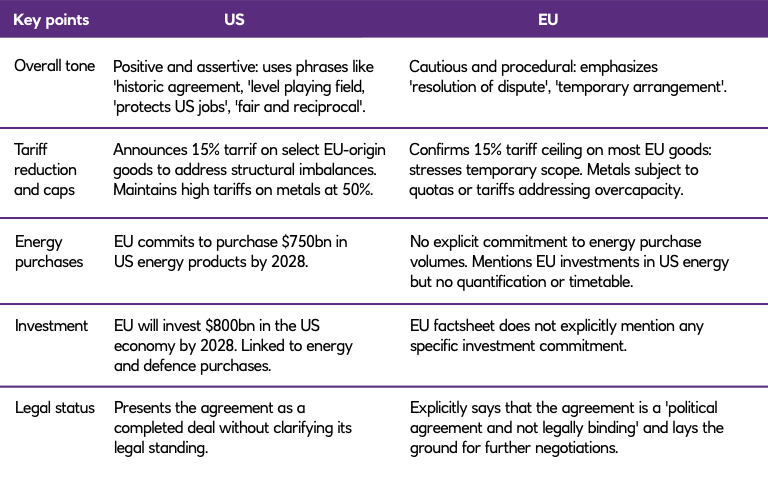
While both highlight strategic alignment, there are substantial asymmetries in tone, quantification of commitments, and tariff implementation (see table below). The EC states that the political agreement is not legally binding, and the both sides still need to negotiate further to implement it.

The EU and US factsheets at a glance

Moreover, the scope of zero-for-zero tariffs remains unclear. For now, tariffs on aircraft, certain chemicals, generic drugs and natural resources will return to pre-existing (lower) levels.

The EC factsheet indicates further negotiations will aim to add further product categories to this list. Furthermore, how sectoral tariffs – and the results of a Section 232 investigation into the national security implications of US pharmaceutical imports – might add to or replace the rate agreed remains uncertain. A joint EU-US notice is expected soon, which hopefully will provide more clarity.

4. The deal will affect EU member states differently

Setting aside services, we think there will be a 15% tariff on 70% of the €531.6bn total of goods exported to the US (based on 2024 figures), which in our estimate will reduce export demand by roughly €27.9bn, or 0.2% of EU GDP.

Crucially, the impact might not be uniform across EU members, owing to economic diversity within the bloc. For instance, Germany is the largest exporter of goods to the US, and German export-oriented industries, particularly the automotive sector, are highly exposed. And higher tariffs are a downside risk to the Irish export-led economy, led by pharmaceuticals, medical devices, information and communications tech, and aircraft leasing exports – much of which are US-bound.

5. Europe’s loss might be Europe’s gain

Overall, the deal looks like a defeat for the EU, but context is key. Firstly, a 15% tariff is comparable to, or even better than, those faced by other exporting countries to the US, potentially enhancing price competitiveness for EU goods. Secondly, decreasing uncertainty could boost firm-level investment within the EU. Furthermore, the US's privilege in the global financial system remains intact, but its unpredictable trade behaviour suggests EU businesses may diversify investments away from the US.

These shifts could support the euro and European assets, a trend evident in recent months. For the EU to fully benefit, it must enhance domestic demand, uphold the rule of law, and improve the Single Market’s functionality. However, these challenges have been around long before ‘liberation day’.

To read more Market Insights click here.

This material is published by NatWest Group plc (“NatWest Group”), for information purposes only and should not be regarded as providing any specific advice. Recipients should make their own independent evaluation of this information and no action should be taken, solely relying on it. This material should not be reproduced or disclosed without our consent. It is not intended for distribution in any jurisdiction in which this would be prohibited. Whilst this information is believed to be reliable, it has not been independently verified by NatWest Group and NatWest Group makes no representation or warranty (express or implied) of any kind, as regards the accuracy or completeness of this information, nor does it accept any responsibility or liability for any loss or damage arising in any way from any use made of or reliance placed on, this information. Unless otherwise stated, any views, forecasts, or estimates are solely those of NatWest Group, as of this date and are subject to change without notice. Copyright © NatWest Group. All rights reserved.

scroll to top